


Trauma-Informed Leadership
Internal & External Leadership
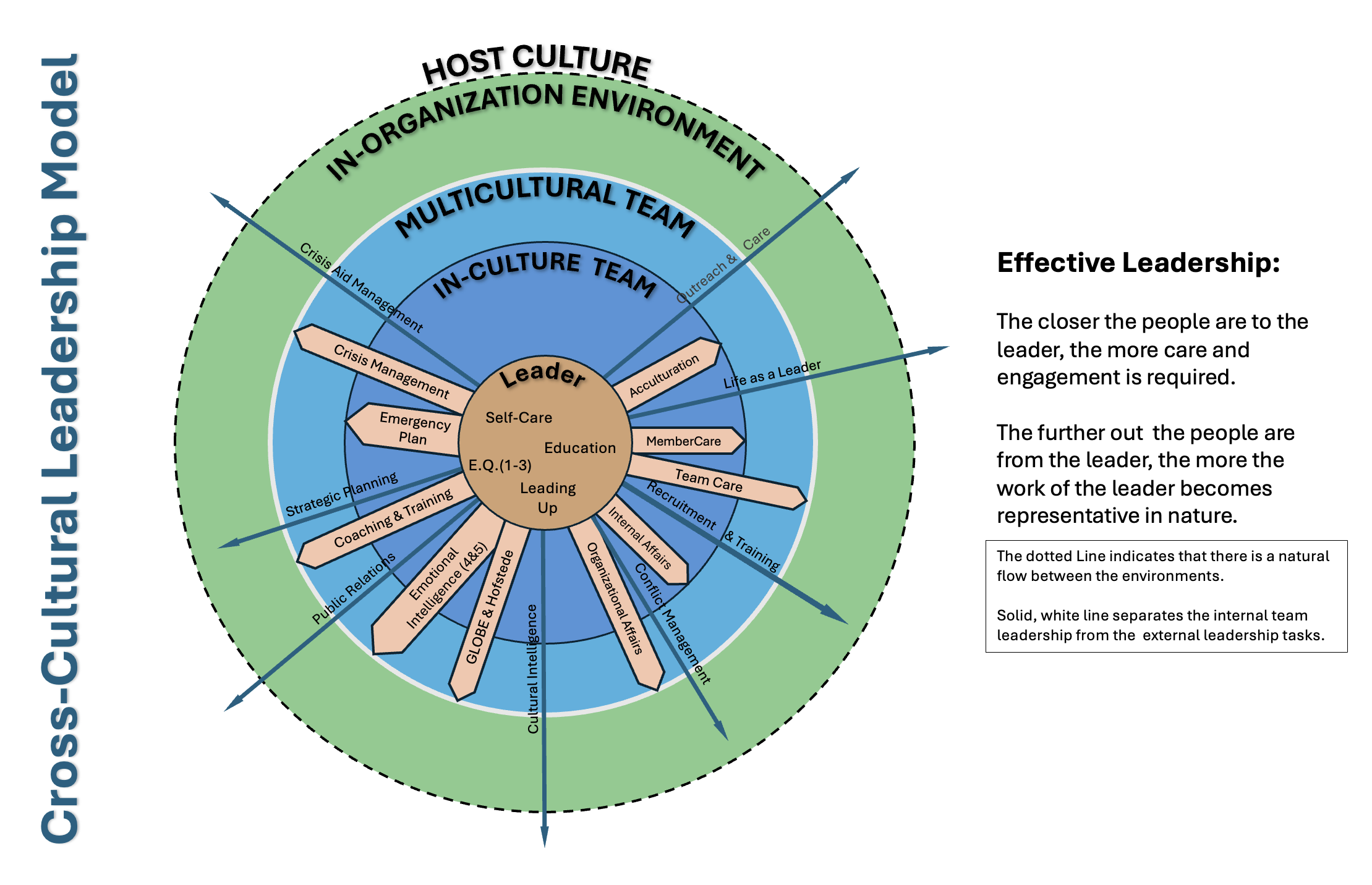
Leadership most often includes several layers of influence. Any executive-level leadership requires a leader to represent the organization to the outside in some capacity. Field directors for missionaries, for example, represent the worldwide missions organization not only to partner churches and paraorganizations but also to the larger host country. Some missionary leaders might even hold some official role within a tribal council.
The further inward, the leadership role shifts from representative to things like strategic planning, eventually landing at the level of individual care of team members. Within the cross-cultural environment, the leader will then be confronted with managing intercultural relationships within multicultural teams, or may have to lead homogeneous teams through cross-cultural challenges. Either job requires the leader to have a high level of cultural intelligence and emotional intelligence.
The image to the left shows just a few examples of the “inward vs. outward” dynamic a cross-cultural leader must manage.

The Concept of Trauma-Informed Care
Trauma-Informed Leadership is not a new leadership style such as directive or servant leadership. “Trauma-Informed” is a tool used in mental health care, coaching, and, more recently, in leadership and management contexts. A tool because it is something that leaders - and caregivers, for that matter - should use when dealing with people. Trauma research is relatively new, and much remains to be discovered. However, it is already apparent that trauma can affect any person. The challenge for the leaders is that they can’t see from the beginning if the person they are leading is dealing with a traumatic past.
So what is trauma? What does it mean to be trauma-informed? And what is trauma-informed leadership?
-
At the most basic level, trauma occurs when an individual experiences a horrific event or a series of events that is so severe that a normal, logical response is not possible and the “fight, flight, or freeze” response kicks in. Some people might experience the same event, but react totally differently. While one person is able to logically process the situation, another might freeze and be unable to do anything about it. Again, others might go into a fight-or-flight response. The key here is that these reactions can occur even days later.
One example might be a car crash: while a person might be able to call the emergency services, organize the scene, and even help in the moment, a few hours or days later, the same person might be “hit with reality” and, when asked, not recall the event or the hours before or after. While some will slowly regain memory of the event, others might block it out for the rest of their life. However, a familiar smell or sound may bring back the horrific feeling of the event and throw the person into a freeze response and utter anxiety. If the person does develop ongoing disabling symptoms, these behaviors would then be considered PTSD (Post-traumatic Stress Disorder).
Just as disabling as PTSD can be what is known as complex PTSD or C-PTSD. Complex PTSD can develop when a person is exposed to immense stress over a prolonged period of time. In most cases, this is not just stress but trauma-inducing behavior such as abuse or neglect. An individual who has been abuse -sexually, physically, mentally, or spiritually- over a prolonged time, without being able to escape (flight) or defend themselves (fight), will eventually find some way to respond.
In some cases, it might even be a fight response, when the person gradually builds up the courage or finds a fighting chance. It might even be a flight response when the person sees a way out of the abusive relationship. But it can also be a freeze response or a fawn response. A freeze response might be observed in someone who has given up looking for options and does nothing. A fawn response is when an individual starts appeasing the abuser just to avoid triggering an abusive action.
While these explanations are very much simplified, they all explain in simple terms what goes on within a person while trauma-inducing events or behaviors happen to them. And while some people might say they grow up and are no longer affected by them, Bessel van der Kolk responds with a book title: The Body Keeps the Score. Somewhere in the innermost being of a person, past events and the complexity of life are stored. And if there is no healing process, things can be triggered at any moment, preventing a person from living a normal life or working normally. - This is where the Trauma-Informed approach in the next section comes into play.
-
(I know you are looking for the follow-up. Let me put it together and I will post it as soon as I have it ready)
-
(Check back for more)
(Come back for more in Trauma-Informed Leadership)